"Power" Walking
TAoN No. 204: A different way to notice your neighborhood (for the better). Plus a new Icebreaker, and more
Hey y’all. Happy Lunar New Year, and Happy Mardi Gras (and if you get to this a little later then Happy Ash Wednesday and Happy Ramadan).
Today: walking. As if it weren’t a virtuous enough and constantly recommended activity already, The New York Times now suggests (gift link) it can be a first step toward civic reform.
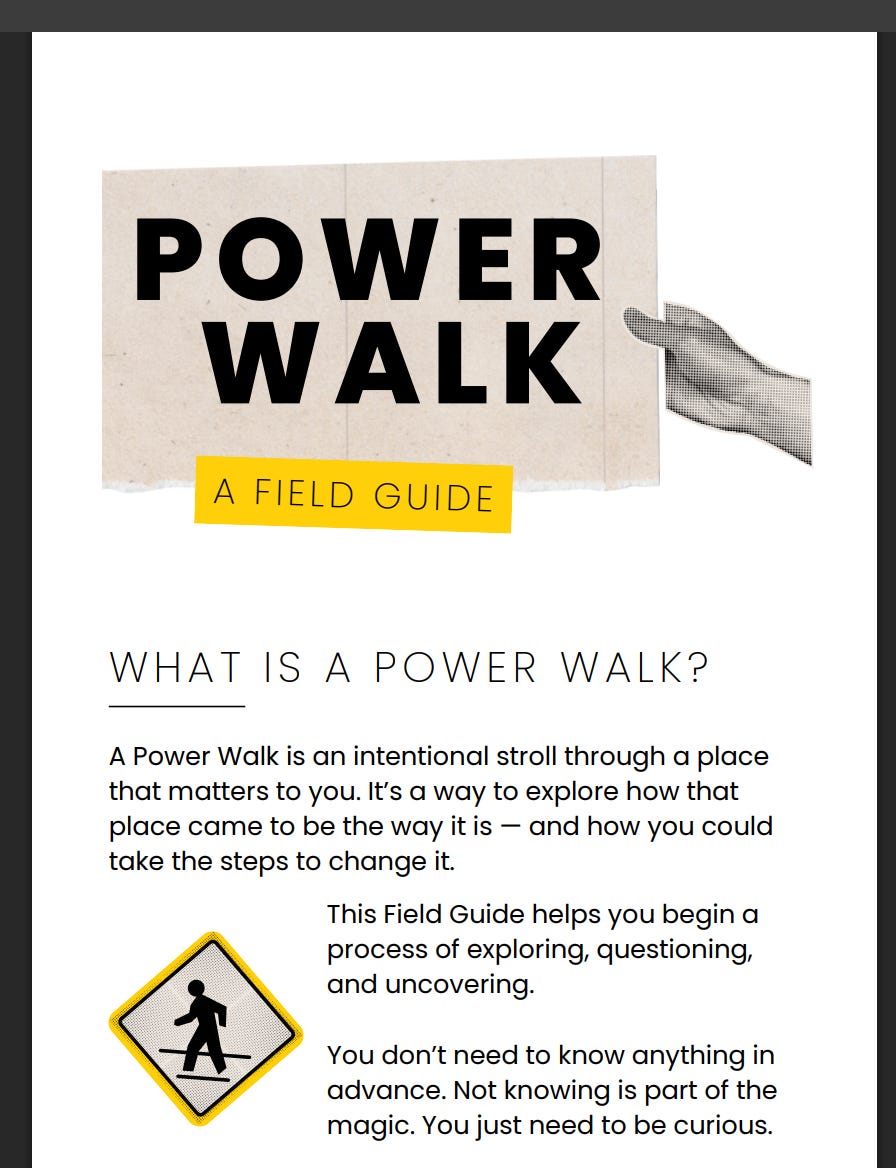
Specifically, The Times and Citizen University propose a form of walk that amounts to “an exercise for mapping civic power in a geographic space.”
Look around your neighborhood, Citizen University suggests: “Have you ever wondered… how did things come to be this way? Who made the choices that shaped this place? And what’s changing right now, often without us noticing?”
The Times writes:
At its core, the Power Walk is a new lens through which to see a neighborhood, guided by a series of prompts to reflect on what could change and where capacity exists to change it. It’s a way of understanding the possibilities that people see in the world around them, and discussing what collective power they have to realize those possibilities.
The Times article tells the story of citizens reshaping a lower Manhattan neighborhood, including the conversion of unused land into a public park. It all started with locals looking around and asking questions about what could change, and how.
To help encourage such outcomes elsewhere, Citizen University has made a Power Walk field guide, and I really like some of the questions


These questions prompt you to attend to and consider your neighborhood in new ways, even if you don’t have specific ideas for changes. And who knows — after a walk or two, maybe you’ll have a few!
(That Times article, by the way, ends with a call-out to anyone interested in trying a Power Walk wherever you are. Go here and scroll to the form at the bottom if that might be you!)
Noticing is about other people, too. The Icebreaker series aims to help with that. There’s a central collection spot for all the icebreakers to date, here.
Today’s Icebreaker comes from Melvin Adekanye:
“What three words would your friends use to describe you?”
Melvin is a bona-fide icebreaker expert! He’s the founder of JamSocial, a platform for starting conversations and connections at events. More about their Jam Bingo game here.
To me this question inspires two spinoffs — what three words do you wish they would use, and (hardest to answer in conversation, I suppose) what three might you fear?
Thank you so much, Melvin!
Please send your favorite icebreaker (whether you made it up or found it elsewhere) to consumed@robwalker.net.
SUPPORT TAoN
If you enjoy TAoN, please become a paid supporter. You’ll get access to the full archives as well as supporter-only bonus posts and discussion threads. Your support makes this newsletter possible.
—> ALSO: Check out the recent TAoN creative-attention Zoom workshop on turning moments into haiku, led by writer/photographer/traveler Lisa Germany.
Thank you!
IN OTHER NEWS
Spurious Correlations (example above). I love this project so much. (Via Kottke)
Badass Olympic skeleton-racer helmets.
“Rather than keeping a diary, I started keeping notebooks. Where a diary constructs narrative, character and voice, a notebook is inherently fragmented, allowing for unexpected glimmers of serendipitous juxtaposition and lyric voltage.” Essay By Daniel Poppick
An online museum of Typographic Objects. (Via Heller, who has an interview.)
Book cover designer Oliver Munday on someone else designing his book’s cover.
“The earliest known example of possible operative dental work dates to approximately 14,000 years ago in northern Italy.” Fun fact from this piece about why earlier humans had straight teeth without braces.
Street art interacting with reality.
“This page intentionally left blank.” Why that is.
KBB on 20 years of drawing stuff she bought, and “the strange comfort of repetition.”
OKAY THAT’S IT!
As always, I value your feedback (suggestions, critiques, positive reinforcement, constructive insults directed at me, not at anyone else, etc.), as well as your tips or stories or personal noticing rituals, things we need a word for, and of course your icebreakers: consumed@robwalker.net. Or use the comments.
—> Or just click the heart symbol. That always makes my day.
And thanks for reading …
rw
RobWalker.net | NB: I use (some) Amazon Affiliate links
All this by Rob Walker PO Box 171, 748 Mehle St., Arabi LA 70032.
—> Send me mail! I’ll give a three-month free trial to the Supporter version of TAoN to any current free subscriber who snail-mails me a request (include your email address).
To unsubscribe see the bottom of the email, or go here.


Jane Jacobs, famously “just a citizen,” nearly single-handedly saved Greenwich Village and coined the phrase “eyes on the street.” She lived in the neighborhood and was invested in seeing it saved. Every walk should be filled with appreciation for what is and imagination for what could be. I’m a huge proponent for “pocket parks.” Much better than disused vacant lots which fill rather quickly with heaps of trash.
On a related note I recommend John Stilgoe's book 'Outside Lies Magic' which is about seeing and understanding our built environment, and a very TAONish book indeed. I lost my copy, which I picked up at a secondhand bookshop (long gone 😢) but I see there is a copy on eBay.