
Group Thinking
TAoN No. 198: Lessons from The Noticers on shared attention. Plus a new (related) Icebreaker, and more
[ Bit of an epic-length post today, but no apologies! It’s full of fun, useful stuff. Here goes! ]
A major highlight of 2025, for this newsletter and for me, came in a letter from Tanja, in Vienna, Austria, who wrote:
“I have made a little club (is it a club if we so far only have 3 members?) called The Noticers, and we meet every two or three weeks and come up with projects inspired by TAoN. We then come up with creative ways to show our results.”
She enclosed an example. The Noticers had settled on noticing triangles as one of their prompts, so she had created a zine about triangles. I loved it!
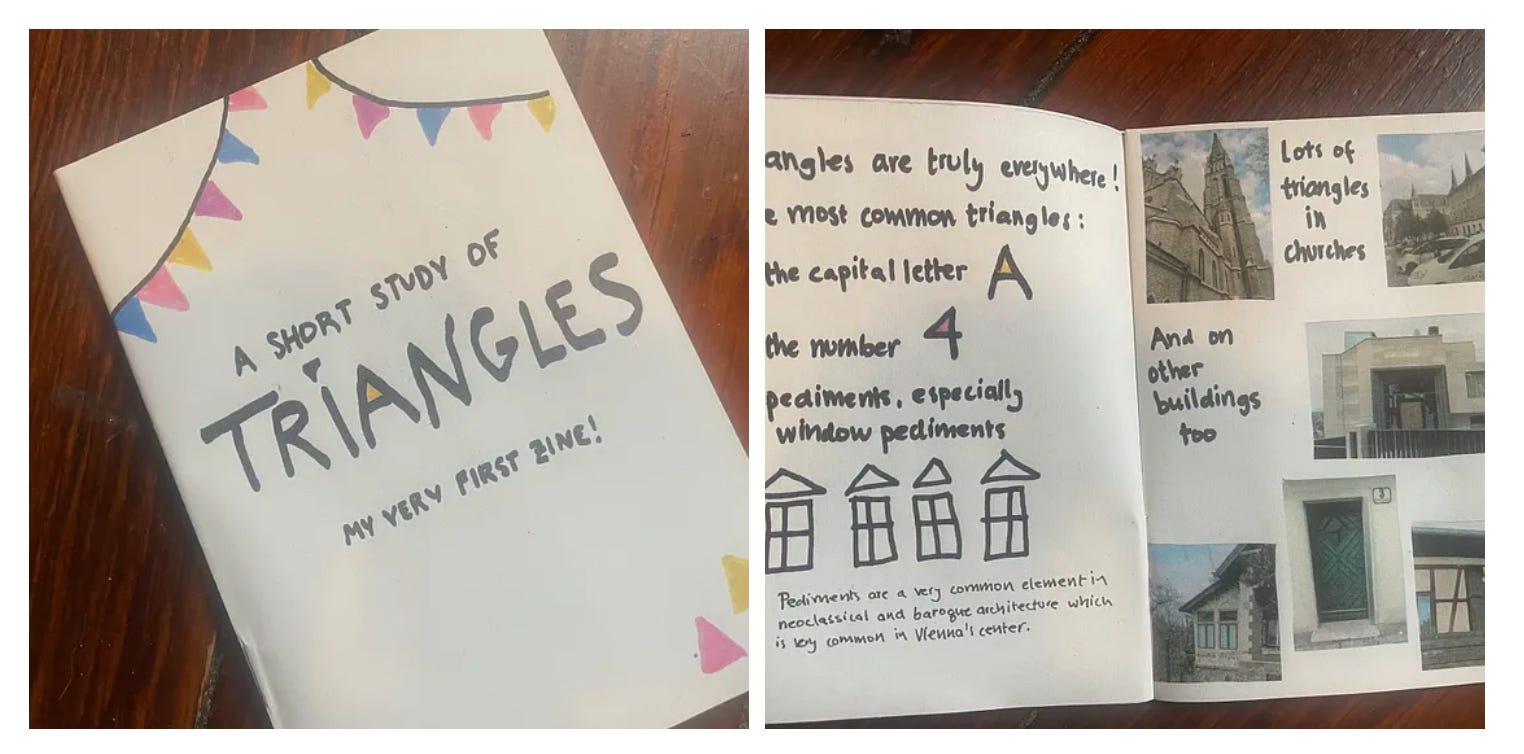
But I really loved the group context — and so did some folks in the comments on that post, who expressed interest in forming similar groups. Reader Phyllis, for example, requested that I make some effort on this front: “I’m thinking it would be helpful to suggest ways to explain the concept so that friends who don’t know your book would be eager to join.”
Could I (should I?) do something to encourage more noticing groups? My first move was to arrange a Zoom call so I could meet The Noticers!
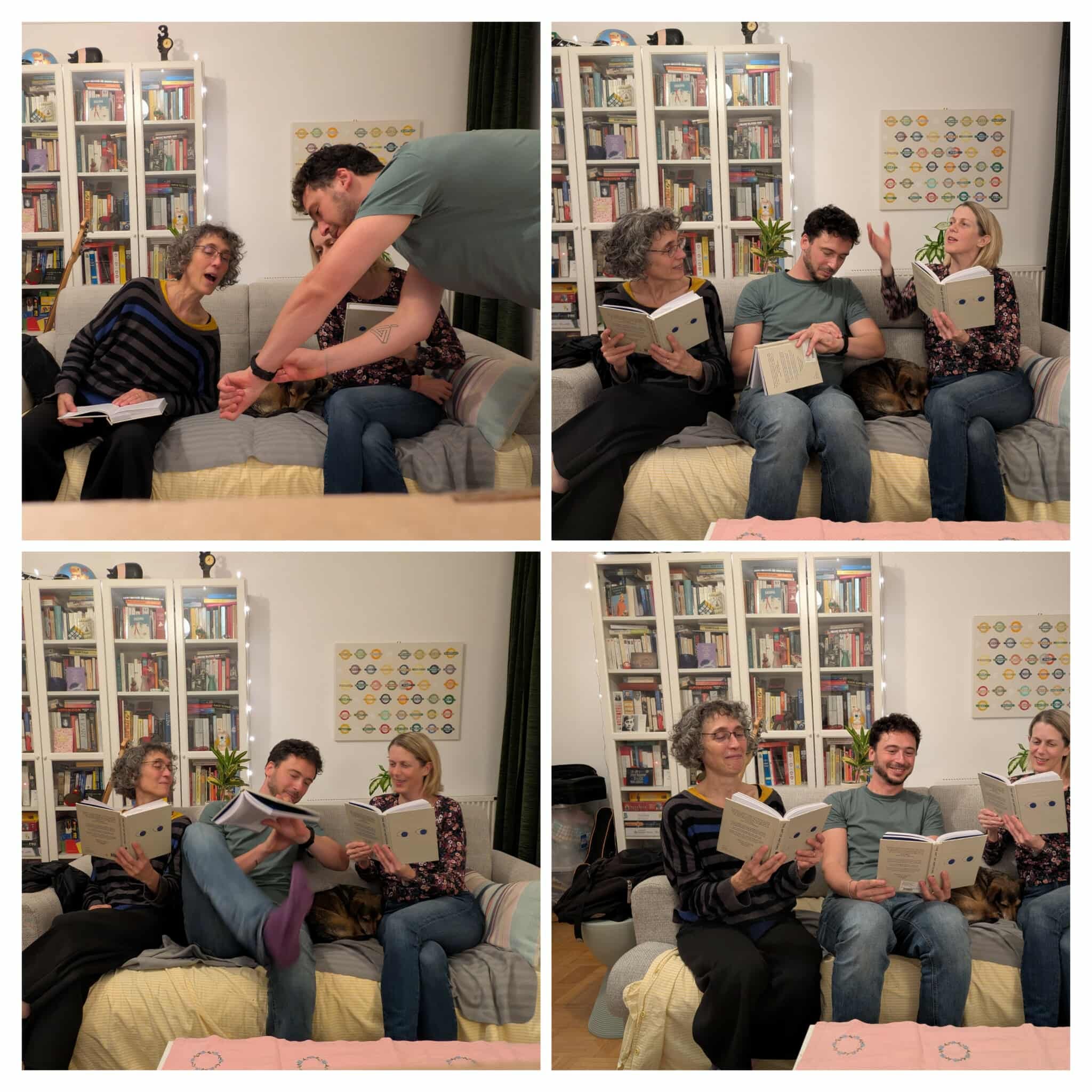
Of course they were unbelievably charming. They were also inspirational — and very eager to offer encouraging thoughts, tips and suggestions on noticing groups. I’ll offer some of their ideas, some of mine, and some from others.
DON’T OVERTHINK IT!
The Noticers’ back story wasn’t complicated; it was straightforward and chill.
Tanja found her way to TAoN (book and newsletter) by way of my contributions to the Waking Up app. She’s clearly a natural noticer, and declares a deep dislike of smartphones. She was into the book, and bought a copy for her friend Ann. Their colleague/friend, Tomi, joined starting at their second meetup. Tanja explains:
We decided we’d give ourselves projects every two or three weeks where we’d do some sort of noticing exercise and then [get together and] share our results in whatever random fashion we wanted to. ... At that meeting we talk about how the project went for us and then decide our topic for the next project.
While they agree on a noticing subject (like triangles), what they do about it as a result is left up to the individual. Thus Tanja’s zine. Ann addressed her triangle observations with a science-project-style writeup:


ACCEPT THAT THIS IS NOT FOR EVERYBODY
“I would so love to have more members,” Tanja wrote, “but quite a lot of people I guess just aren’t quirky enough and don’t quite get it!”
Yes, well, story of my life, Tanja! Not everybody is cut out to be an Artist of Noticing — and that’s okay.
So my suggestion to anyone looking to follow in The Noticers’ footsteps: Send this post to a friends or acquaintance who might be interested1, and don’t worry about those who aren’t. When someone is interested, ask them to invite someone else.
IF THIS SOUNDS LIKE A SILLY IDEA — MAYBE LEAN INTO THAT!
Sometimes the best groups start out as jokes. As I was writing this post, I listened to a video chat between friend of TAoN Austin Kleon, and Priya Parker, author of the widely celebrated book The Art of Gathering. She made this point, and Austin mentioned how much art comes from silliness and jokes, too.
So if you think a “noticing group” sounds funny, then laugh. Laughter is, after all, contagious.
HOW TO NURTURE THE GROUP
The Noticers don’t go out noticing as a gang, but sharing with fellow noticers is obviously a big part of the point. (And it’s an achievement at a time when so many people feel isolated and disconnected.)
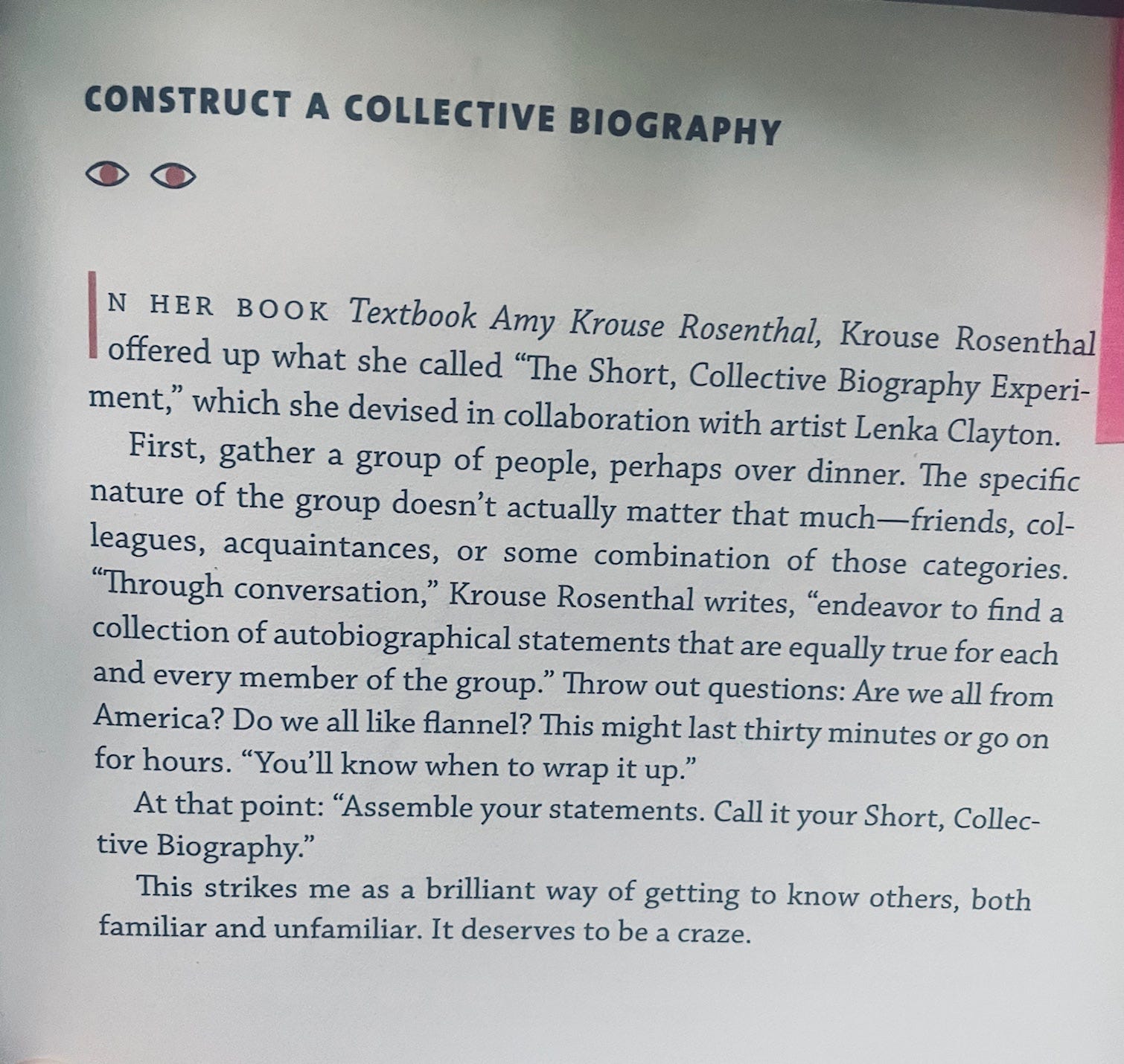
Every year I meet with students in my friend Anne Gisleson’s class at the New Orleans Center for Creative Arts, and I have them do this group biography from the book:
Here’s The Noticers’ collective bio:
“The Noticers are a group based in Vienna, Austria, where they were not born but hope to see Eurovision live next year. They have each lived in at least 5 countries in addition to the country where they were born, have slept on overnight trains, and function in multiple languages. They first crossed paths through their work in higher education and now they enjoy eating cake together while discussing noticing. The Noticers made their first paper zines in 2025 and have made dozens of paper cranes in relation to specific hopes and wishes. Their favorite mode of transport is a bicycle and they have an affinity for googly eyes. They are known by friends and acquaintances as quirky, curious people, and The Noticers gives them an opportunity to express their weird with like-minded folk.”
Here’s a group bio from one of Anne’s classes, with 14 students:
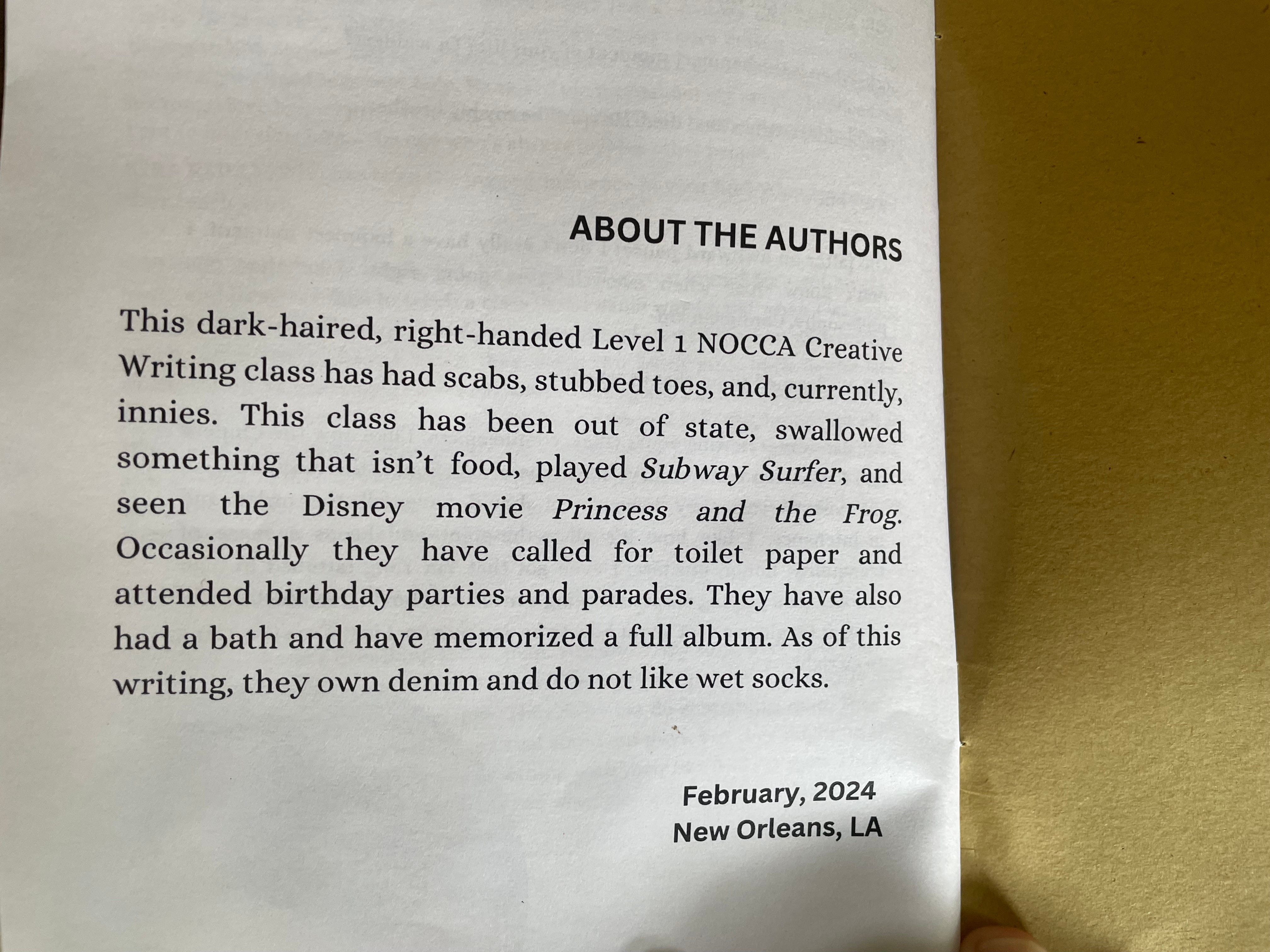
Try this with your own group — noticing-related or otherwise!
MORE NURTURING TIPS
From Ann of The Noticers, in her words:
Meet regularly, be open to playfulness and digression, create a space where sharing feels really comfortable. It’s not about critique, it’s about wonder, seeing how different people process based on the same prompt
Choose people you admire, even if you’ve had different sorts of experiences or are different ages, and who you can imagine wanting to give little gifts now and then (not necessarily requiring purchases). I feel like in our group we are always giving little gifts — both tangible things and observations / encouragement.
Last thing: your group should include people with whom you’re not too worried about being vulnerable, because noticing and how we notice is actually quite personal.
I love all of these!
WHERE TO FIND INSPIRATION FOR PROMPTS
Um, this newsletter? (Especially the Supporter version — multiple prompts and inspiration almost every week, including Savor of the Month!) My book? Just going off the top of my head here ;)
NOT EVERY PROMPT WILL “WORK.” EXPERIMENT!
I think it’s important to note that The Noticers had some hiccups. Some prompts “went off track a bit and got too complicated,” Tanja reports. The idea of “noticing conversations” turned out to be unwieldy, for example. It was better to have more restrictions.
(Your mileage may vary of course. The main character in Rachel Cusk’s 2014 novel Outline, is a writer. At the start of a workshop, she “asked each of [her students] to tell me something they had noticed on their way here.” At first there’s a nervous silence in the face of such a vague prompt, but then remarkable stories come – although one student is dissatisfied and thinks this is all b.s. I strongly suspect Cusk is writing from experience. Either way I can imagine organizing a meetup in a public place, and requiring each participant to share something they noticed on the way.)
KEEP PROMPTS SIMPLE AND SPECIFIC
So what worked for The Noticers? Looking out for triangles, obviously. Another successful prompt was noticing architectural details on buildings, Tanja says: “I wrote a selection of poems based on some reliefs on a building I regularly walk past on dog walks.”
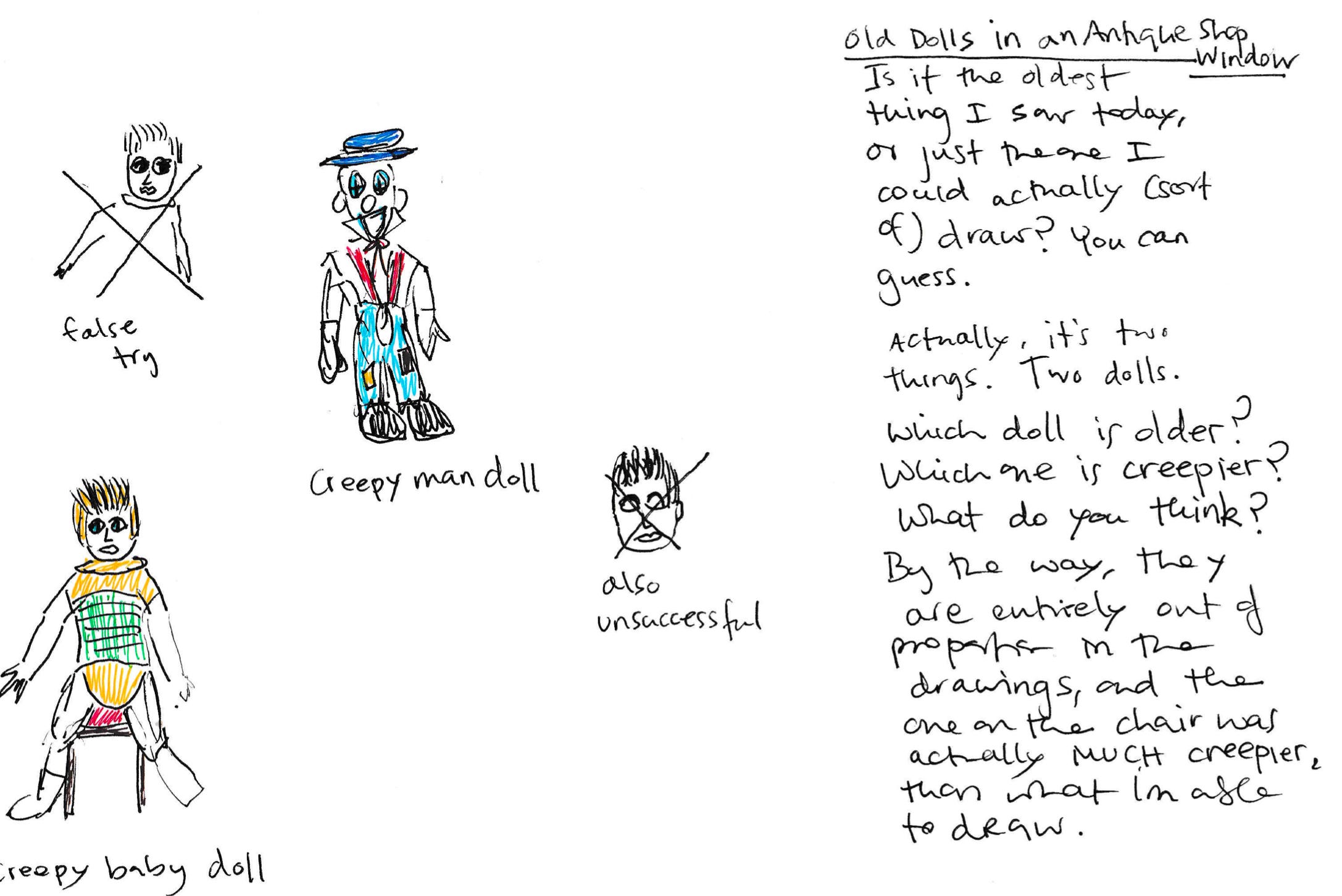
Other fruitful prompts included crosses and “the oldest thing you saw today.”


CONSIDER COLLECTIVE PROJECTS
I’ve written a bit in the past about collaborative attention efforts. For example, every year, E (my wife) and I pick some overlooked feature of the built environment to pay attention to, separately; we collect snapshots for a calendar. Last year we focused on discarded seating; this year we’re doing dumpsters. As I wrote earlier:
Obviously, this sort of attentional team-up could involve pairs (or larger groups) of friends, colleagues, fellow students, etc.; attending to the same physical environment, or to distant ones; over a specific period of time or an open-ended one. It could lead to collaboration, or simply serve as prompts to think of each other. You could make it part of a game, a competition, even a sort of attention-accountability check. There are, I suspect, plenty of ways like this to share attention
I got a great reply to that post from Karin Betts, who wrote:
“My friend Ryan and I live 2000 miles away from each other and have been ‘collecting’ found change together since 2016. When we find pennies, nickels, dimes or quarters (on the sidewalk, in an Uber, in the dirt, wherever) we photograph them either in-situ or in our hand and then text the photo to each other and keep a running tally of how much we’ve found. We’re connected in ways we would not have been without this shared-despite-being-far-apart project — and we’re up to $92.07!
More here, but the point is this same shared-attention-as-game strategy could work with a group — even a far-flung group.
CONSIDER REAL-TIME OPTIONS
Ann has used noticing exercises with language students that could work in a group. With one student in an individual course, Ann had her do a 20-minute exercise noticing the color blue on one of Vienna’s main pedestrian shopping avenues. They compared notes and found they had noticed in very different ways. “After that, she would ask me about noticing or mention things she’d noticed herself; it felt like she saved these things up for me,” she reports. “She was especially into the mystery noticing project and once noticed AN EGG IN A CLOTH BAG IN THE MIDDLE OF THE STREET.”
Separately, Ann invited a group of six people in a language cafe session to try a version of a noticing sounds activity. “We sat there, seven strangers, for 3 minutes, the six of them with their eyes closed, and listened to sounds (traffic, public transit, some people having a loud conversation, and so forth). Then we discussed what we’d heard. They didn’t feel like three minutes was a long time to sit in silence with people they didn’t know, and they all thanked me. One man said it was a reminder that we can always find that calm. It was very beautiful.”
DON’T LET THE “CREATIVE” ELEMENT TAKE OVER
This one is from me: I would be very careful not to let the “creative project” side of the equation take over. You don’t want to end up choosing subjects based on what will make a cool project. That sort of defeats the purpose. Make this about what captures your attention — not your professional self, or your current-events self, or some other traditional identity or affinity.
STEAL IDEAS FROM OTHER GROUP TYPES
The Wall Street Journal recently ran an article (gift link) about journaling clubs — people get together and respond to prompts (draw a giraffe with your eyes closed; reflect on a meaningful gift, etc.), silently, in their journals. Then they talk about what they’ve drawn or written. “More and more journaling societies are popping up,” says The Journal, from living rooms to parks.
Clearly there have been all sorts of excuses to gather and converse — book clubs, wine clubs, etc. — and in the same way that journaling “societies” encourage journaling more generally, gathering to discuss what you’ve noticed encourages attention and presence. So invent the rules that work for you!
(Also I really like calling them “societies” — noticing societies sounds amusingly fancy!)
WHAT ELSE MIGHT INSPIRE MORE NOTICING CLUBS?
How about a discount for group subscriptions to the Supporter version of this newsletter? See offer below.
And/or perhaps I could offer noticing club stickers? Another point Parker and Kleon discussed is the importance (for both gathering and creativity) of costumes and “props.” (A little group I’m part of recently introduced badges — it’s jokey but it’s also really great.)
Should I offer to host a (limited-size) experimental online noticing event? Or offer to drop by yours? (This would ultimately have to be a Supporter thing, although maybe not at first.)
Tanja suggested: “Perhaps another way to inspire people to start clubs would be if we had a place online where people could share their projects to inspire each other as well?” See the chat note below.
I’m just floating ideas here, no promises ;)
I would love your thoughts, ideas, and feedback on this one!
And I’ve started a dedicated chat thread here.
My deepest and most attentive thanks to The Noticers, Tanja, Ann, and Tomi!
SUPPORT TAoN
If you enjoy TAoN, become a supporter with a paid subscription. You’ll get access to the full archives as well as supporter-only bonus posts and discussion threads — and, most important, you’ll help keep this free, flagship edition alive for everyone!
THE NEXT FREE EDITION IN TWO WEEKS!
Noticing is about other people, too. The Icebreaker series aims to help with that. There’s a central collection spot for all the icebreakers to date, here.
Today’s icebreaker comes from … The Noticers! Inspired, I am told, partly by the recent post about Artists of Noticing.
If you had to describe yourself in five phrases, what would they be?
To wit:
Tanja: Dog Mama, Wannabe Tom Lehrer, Regretful Nomad, Reluctant Spinster, Luddite
Ann: Intuitive Sparring Partner and Encourager, Storyteller and Apprentice Novelist, Maker of Sunshine, Nourisher (when not overwhelmed)
Tomi: Metaphor man, Shrimp keeper, Long distance Friendship nurturer, Addict to the Education sector, Tall enough to reach the specialty coffee jar
Me, Rob Walker, the guy writing this newsletter: Kindness aspirant, Curiosity advocate, Public pool enthusiast, Friend of animals, Intolerator of bullshit
Please send your favorite icebreaker (whether you made it up or found it elsewhere) to consumed@robwalker.net.
IN OTHER NEWS
“In these grim times, the most efficient path to living a contented life may be to put ourselves through the simple exercise of thinking about our purpose and then taking a step — even a modest one — toward fulfilling it.” (Thanks Lynn!)
A Car & Driver writer enters the Pittsburgh Parallel Parking Championship: “I went to the competition without a single practice run, convinced the spatial awareness passed down from my ancestors would handle the rest.”
Kelsey McKinney on Lily Allen’s new album, which is quite good: “West End Girl feels like an album the artist had to make for herself to move on. That’s the kind of art I want to listen to: art that means something to the person who created it.”
Obit of the month: Fluxus participant Alison Knowles. Have a very specific tuna sandwich lunch in her honor.
OKAY THAT’S IT!
As always, I value your feedback (suggestions, critiques, positive reinforcement, constructive insults directed at me, not at anyone else, etc.), as well as your tips or stories or personal noticing rituals, things we need a word for, and of course your icebreakers: consumed@robwalker.net. Or use the comments.
—> Or just click the heart symbol. That always makes my day.
And thanks for reading …
rw
RobWalker.net | NB: I use (some) Amazon Affiliate links
All this by Rob Walker PO Box 171, 748 Mehle St., Arabi LA 70032. Send me mail!
To unsubscribe see the bottom of the email, or go here.

And really you should be telling all your friends about this newsletter, regularly ; )
What a lovely group! I cannot begin to express my love for ‘zines. Zines simultaneously say: I write, I publish and I share. My hope one day is that every little free library hosts zines written by locals to share their thoughts with their neighbors.
I noticed something yesterday that I hadn’t noticed before. Laugh if you must. Inside my faux fall flowers hanging on my glass screen door is a hidden bird’s nest. I saw the bird fly into the decoration but not exit. This morning I confirmed what I thought I saw. And heard the bird squawking at me nearby because I was blocking access to his home. I promise I’m not a recluse. I leave the house regularly. Now I want to write a zine dedicated to birds. I love them so much.
This is delightful. I agree that we should all be starting societies, a word that feels just the right amount of silly pretentious--so that we both take our group seriously and also not at the same time. The world is just too damn serious most of the time.